




The best way to exfoliate sensitive skin is with a gentle method you can control, about once a week. That means avoiding gritty scrubs and strong acids in favor of something that lifts away dead skin cells without rubbing or stinging. Sonic dermaplaning with DERMAFLASH LUXE+ is a dermatologist-recommended way to exfoliate that sweeps away dead skin cells (and peach fuzz) in a smooth glide. Its “Gentle” speed setting is designed for sensitive skin, and its once-a-week routine helps you avoid over-exfoliating.
What Does “Sensitive Skin” Actually Mean?
Surprisingly, there’s no single standard test for sensitive skin. Instead, experts define it by how your skin feels (International Forum for the Study of Itch, 2017). If you experience unpleasant sensations like stinging, burning, tingling or redness—triggered by skincare products or by environmental changes—you most likely have sensitive skin.
Sensitive skin is incredibly common. A 2020 systematic review and meta-analysis in the Journal of the European Academy of Dermatology and Venereology found that 71% of people report some degree of sensitive skin, and 64% report sensitivity on the face specifically. Women were more likely to report it than men.
Should You Exfoliate Sensitive Skin at All?
Yes. Sensitive skin still benefits from regular exfoliation. Why? For one thing, when dead skin cells build up on your skin’s surface, they can leave skin with a rough texture and a dull, flat appearance. Dead skin cells also form a barrier that keeps your serums and moisturizers from absorbing the way they should. And with the right tool, the benefits go beyond the surface: LUXE+ Sonic Dermaplaning also supports cellular turnover, and with consistent weekly use, it’s clinically proven to improve the look of fine lines, wrinkles and dark spots. That said, if you have sensitive skin, it’s crucial to:
- Use a gentle exfoliation method you can control
- Avoid over-exfoliating
The American Academy of Dermatology notes that over-exfoliating can leave skin red and irritated. For sensitive skin, the goal is gentle and consistent exfoliation—not intense and frequent.
What Are the Main Ways to Exfoliate Sensitive Skin?
According to the AAD, at-home exfoliation falls into two main categories: mechanical (a tool or scrub that physically removes dead skin) and chemical (acids that dissolve it). Sonic dermaplaning is a newer option that works differently from both of these classic approaches.
- Scrubs and brushes: These rely on grains or bristles rubbed across the skin. The AAD cautions that this kind of mechanical exfoliation may be too irritating for sensitive skin.
- Chemical exfoliants: Alpha and beta hydroxy acids (AHAs and BHAs) dissolve dead skin cells. For sensitive skin, the AAD suggests a mild formula, since stronger chemical treatments are better suited to oily, thicker skin.
- Sonic dermaplaning: A precision edge glides across the surface of the skin to lift away dead skin cells and peach fuzz. There’s no grit to scrub with and no acid left on the skin.
How Is Sonic Dermaplaning Different From a Scrub?
If the AAD says mechanical exfoliation can be too much for sensitive skin, it’s fair to ask why dermaplaning belongs on this list. The answer is in how it moves.
A scrub works by rubbing. LUXE+ works by gliding. Proprietary Sonic Technology powers 14K sonic vibrations per minute, the optimal speed for deep yet gentle exfoliation. Those vibrations give the patented MicroFine Edge™ a smooth, frictionless glide across your skin, while a proprietary Safety Cage protects against nicks and scrapes.
You also get to choose your intensity. LUXE+ has two sonic speed settings: Gentle, which is ideal for beginners and sensitive skin, and Invigorating, for deeper exfoliation. It’s safe for all ages, skin tones and skin types, including sensitive, and it’s recommended by dermatologists and estheticians.
What do the results show?
- It feels gentle: 97% said LUXE+ felt gentle (consumer panel survey after using LUXE+ once).
- Texture improves right away: 100% saw instant improvement in skin texture (consumer panel survey after using LUXE+ once).
-
Results build over time: 97% had less visible fine lines and wrinkles (instrumental analysis after 4 weeks of consistent weekly use).
As for what it feels like, you’ll notice a gentle glide and a light “sweeping” sensation, along with the soft hum of the sonic vibration. There’s no pain involved.
How Do You Exfoliate Sensitive Skin With LUXE+?
The routine takes just a few minutes, once a week.
- Prep: Remove your makeup and sunscreen. Lather PREFLASH® on wet skin, rinse, then pat thoroughly dry. The drier your skin, the better your results.
-
Start on Gentle: If you’re new to dermaplaning or your skin is sensitive, begin on the Gentle setting. You can always move to Invigorating later if your skin wants more.
- Flash: Load a fresh MicroFine Edge. Hold your skin taut, hold LUXE+ at a 45° angle and glide in short, feathery strokes. Avoid your lips, nose and eyelids.
- Hydrate: Apply your favorite serum or moisturizer. Skincare absorbs more effectively on freshly Flashed skin, and the AAD recommends moisturizing right after any exfoliation.
- Repeat weekly: Flash once a week to maintain your smooth, fuzz-free glow. Remember, if you have sensitive skin, more is not more when it comes to exfoliation.
One more detail that matters for sensitive skin: use a fresh Edge every time. It keeps your results smooth and avoids transferring bacteria from a used Edge.
Can You Use Other Exfoliants With Dermaplaning?
You can, as long as you give your skin space. Skip retinoids and peels for 48–72 hours before and after you Flash. The AAD also notes that retinoids, retinol and benzoyl peroxide can make skin more sensitive, so exfoliating on top of them may worsen dryness.
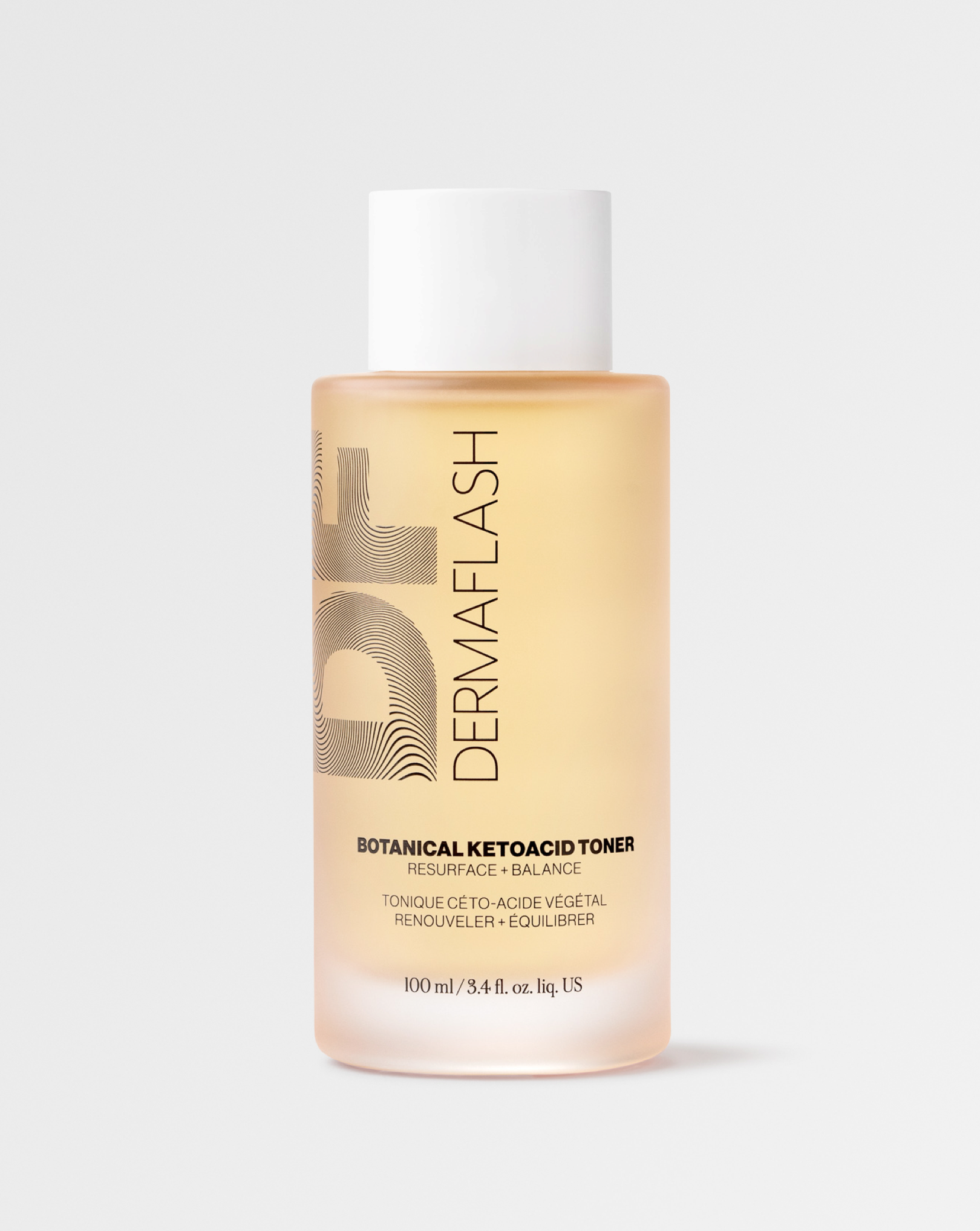
If you want a gentle daily option between sessions, DERMAFLASH Botanical Ketoacid Toner is a non-irritating exfoliating toner that’s safe for all skin types, including the most sensitive. Use it on your device “days off” to maintain your glow.
When Should You Skip Exfoliating?
Even the gentlest method isn’t right for every day. Hold off on exfoliating when:
- You have open cuts or wounds, or your skin is sunburned (per the AAD).
- You’ve used a retinoid or peel in the last 48–72 hours.
- You have a diagnosed skin condition and haven’t checked with your dermatologist about adding a new exfoliation method.
After you Flash, avoid direct sun for 48–72 hours and wear SPF 30+.
Frequently Asked Questions
How often should you exfoliate sensitive skin?
Less often than you might think. In AAD guidance, dermatologists note that dry or sensitive skin may need to limit at-home exfoliation to once or twice a week. LUXE+ is designed for once-a-week use.
Is physical or chemical exfoliation better for sensitive skin?
It depends on the specific method. Harsh scrubs and strong acids can both be too much for sensitive skin. Mild chemical exfoliants and sonic dermaplaning on a gentle setting are both options to consider, and many people use one on their days off from the other.
Does dermaplaning irritate sensitive skin?
LUXE+ is safe for sensitive skin, and 97% said it felt gentle (consumer panel survey after using LUXE+ once). Proper prep, a fresh Edge and the Gentle setting all help, and once a week is all you need. If you notice lingering redness, check what else is in your routine. The AAD notes that over-exfoliating can leave skin red and irritated, so avoid layering scrubs or strong acids on top of your weekly Flash, and skip retinoids and peels for 48–72 hours before and after.
Is dermaplaning the same as shaving your face?
No. Traditional razors are made for terminal hair, the coarse hair on legs and men’s faces. Peach fuzz is vellus hair, which is fine and soft. Disposable razors can miss peach fuzz, damage the skin barrier and cause nicks or cuts. And while a razor only removes hair, LUXE+ is clinically proven to improve skin health.
Will my peach fuzz grow back thicker after dermaplaning?
No. LUXE+ does not affect the hair follicle, and it’s clinically proven that hair will not grow back thicker or faster. As board-certified dermatologist Dr. Ariza Ortiz, MD, puts it: “Your peach fuzz will grow back exactly as it was before you Flashed.”
Sources
- American Academy of Dermatology. “How to safely exfoliate at home.” Last updated February 6, 2026. aad.org
- American Academy of Dermatology. “Evaluate before you exfoliate.” News release, 2015.
- Chen W, Dai R, Li L. “The prevalence of self-declared sensitive skin: a systematic review and meta-analysis.” Journal of the European Academy of Dermatology and Venereology. 2020;34(8):1779–1788.
- Misery L, et al. “Definition of Sensitive Skin: An Expert Position Paper from the Special Interest Group on Sensitive Skin of the International Forum for the Study of Itch.” Acta Dermato-Venereologica. 2017;97(1):4–6.


